Basal Cell Carcinoma
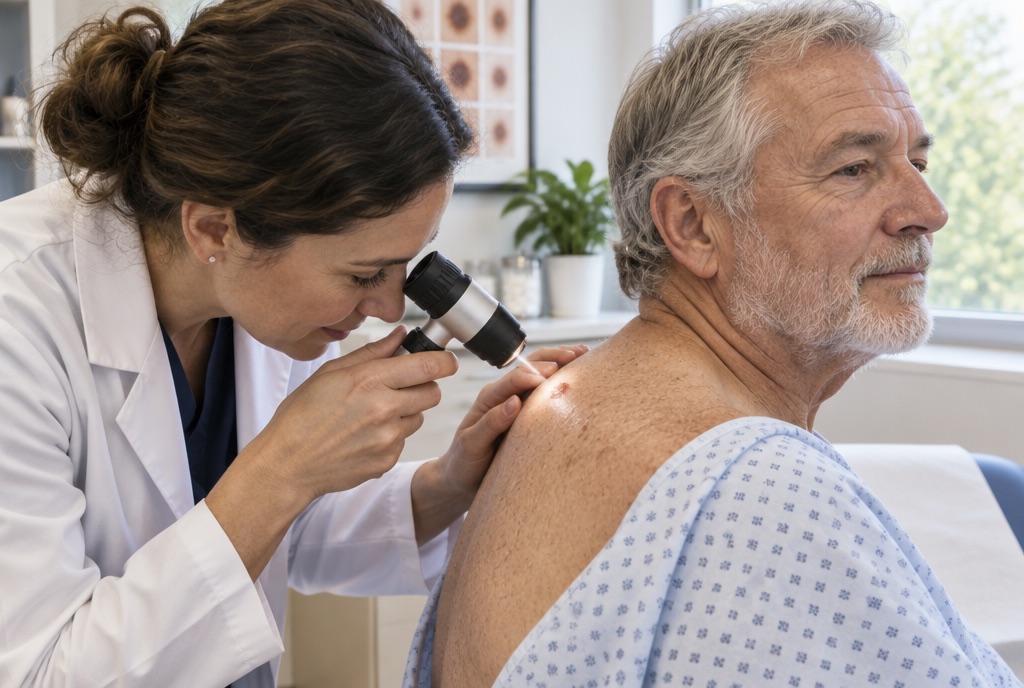
Basal cell carcinoma (BCC) is the most common form of skin cancer, managed per the NCCN Basal Cell Skin Cancer guideline and the AAD Guidelines of Care for Basal Cell Carcinoma.
Symptoms
A pearly or waxy bump, a flat flesh-colored or brown scar-like lesion, or a sore that bleeds, scabs, and doesn't fully heal, most common on sun-exposed skin like the face, ears, and neck.
Causes and risk
Cumulative UV exposure is the dominant driver, along with fair skin, older age, and a personal or family history of skin cancer.
How it is evaluated
Biopsy (shave, punch, or excisional) confirms the diagnosis and subtype, which guides treatment intensity, per both NCCN and AAD guidance.
Treatment
Mohs micrographic surgery is preferred for high-risk BCC, per the NCCN risk-stratified algorithm; standard excision or electrodesiccation and curettage are options for low-risk BCC. Topical imiquimod is FDA-approved and preferred for confirmed superficial BCC up to 2 cm on the trunk, neck, or extremities, though nonsurgical options have roughly a 10% lower cure rate than surgery.
When to seek care
A sore that bleeds, won't heal, or is rapidly growing should be evaluated promptly. Any lesion with high-risk features (large size, aggressive location, prior treatment failure) needs in-person surgical evaluation rather than remote management.